Woodthorpe Church of England Primary School
History
Intent
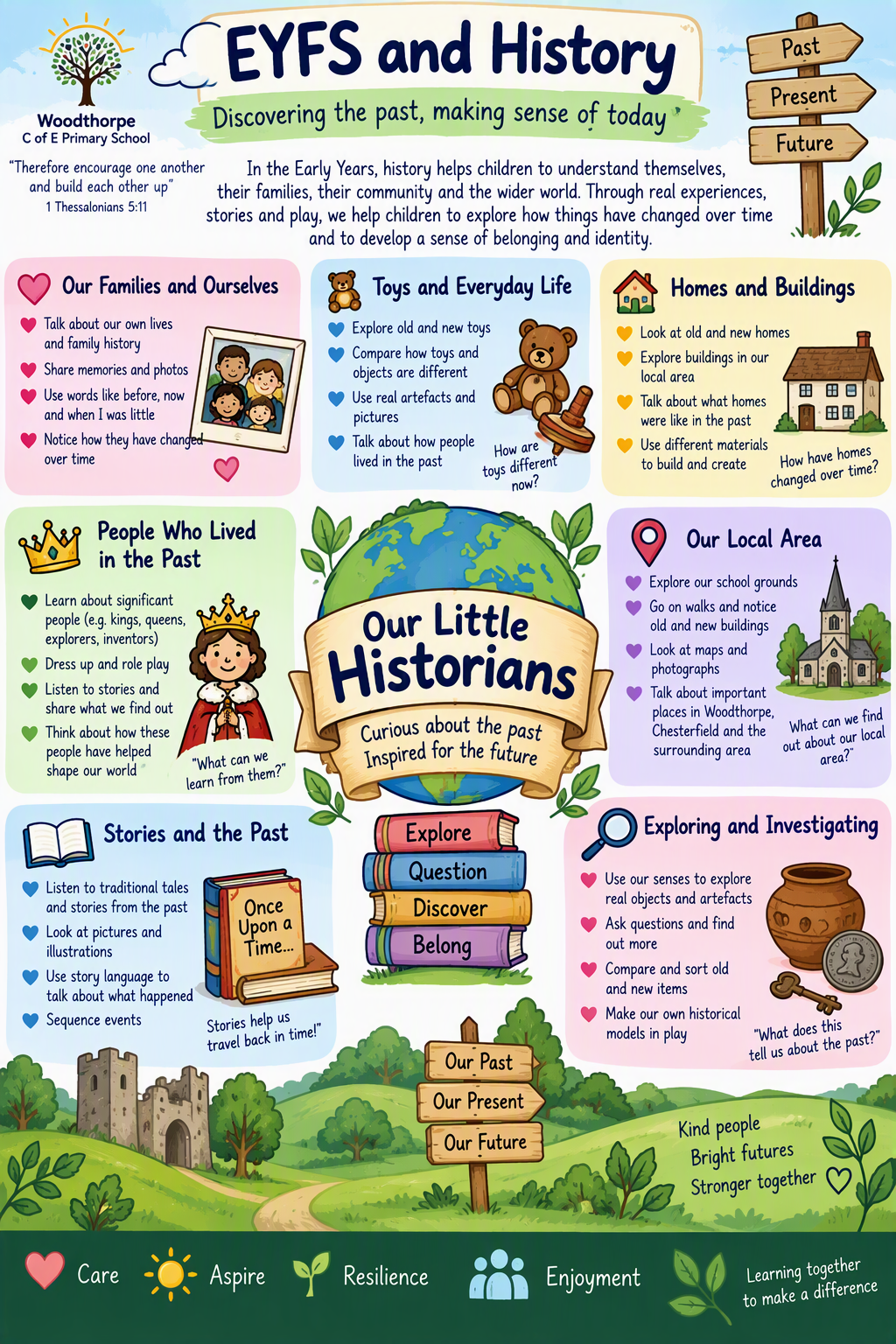
At Woodthorpe C of E Primary School, we want our children to be curious and thoughtful historians who understand how the past has shaped their lives, their local community and the wider world.
Our ambitious and inclusive history curriculum is designed specifically for our children and progresses from the foundations established in EYFS through to Year 6. Children develop secure historical knowledge alongside the disciplinary skills needed to think and talk like historians.
Learning builds progressively from children's understanding of themselves and living memory, to their local area and Britain's past, before extending their knowledge of significant periods, societies and civilisations across the wider world. Our curriculum includes meaningful local history, including changes to homes and transport around Chesterfield and a later local history study, helping pupils understand how their own community has changed over time.
Children progressively develop understanding of chronology, evidence and sources, historical interpretation, cause and consequence, continuity and change, similarity and difference, and significance. This closely reflects the DfE expectation that history should develop coherent knowledge of Britain's past and the wider world while enabling pupils to think critically, weigh evidence and understand methods of historical enquiry.
Our Christian vision,"Therefore encourage one another and build each other up" (1 Thessalonians 5:11), underpins our curriculum. Through history, pupils consider themes including leadership, service, justice, equality, courage, responsibility and how people's beliefs have influenced their actions.
Implementation
Our history curriculum is carefully sequenced so that pupils build knowledge, vocabulary and historical thinking over time.
Through high-quality inclusive teaching, children:
- build chronological understanding and make connections between periods studied;
- develop increasingly secure substantive and disciplinary knowledge;
- investigate the past using photographs, artefacts, maps, buildings, written accounts and other historical sources;
- develop from asking simple questions about the past in KS1 to selecting relevant evidence and, by Y5/6, considering reliability, bias and purpose;
- explore historical concepts including cause and consequence, continuity and change, similarity and difference, and significance;
- make purposeful links with English, geography, science, mathematics, computing, art, DT, RE and PSHE where these deepen historical understanding;
- communicate historical understanding through discussion, writing, ICT, drawing and presentation.
Vocabulary and oracy
Vocabulary and oracy are deliberately progressive.
Children progress from vocabulary such as past, present, long ago, timeline, evidence and source in KS1, towards disciplinary language including chronology, continuity, interpretation, consequence, perspective and bias. Older pupils use structured historical language such as"The evidence suggests...","The impact of this was..." and"One similarity/difference is..." to articulate increasingly sophisticated thinking.
Thinking and metacognition
Children are encouraged to think about how we know about the past, select evidence, question interpretations, justify conclusions and reflect on the strength of their evidence.
As children's historical thinking develops, they move from using provided sources towards making increasingly independent judgements. This aligns with EEF guidance recommending that metacognitive strategies such as planning, monitoring and evaluating are explicitly taught, modelled and scaffolded within individual curriculum subjects.
Enrichment
History is enriched through opportunities to:
- explore local history and the local environment;
- investigate historical buildings, photographs, maps and artefacts;
- hear stories and accounts from older family members and local residents;
- experience historical visits and visitors;
- use real and virtual visits to significant places;
- explore significant individuals and their impact;
- make cross-curricular connections;
- consider themes of service, justice, leadership and courageous advocacy.
Impact
By the time children leave Woodthorpe, we want them to be knowledgeable, curious and reflective historians who:
- have secure chronological knowledge and can make connections across periods;
- remember and confidently use important historical knowledge and vocabulary;
- think and talk like historians;
- ask historically valid questions;
- use evidence and sources to investigate the past;
- understand that accounts of the past can differ and consider why;
- explain cause and consequence, continuity and change, similarity, difference and significance;
- increasingly justify historical conclusions using appropriate evidence;
- understand connections between their own lives, their community, Britain and the wider world;
- appreciate how individuals, communities, beliefs and events have shaped the world in which they live;
- are well prepared for the next stage of their historical education.
The impact of history is evaluated through assessment, pupils' work, pupil voice and curriculum monitoring.
Our History Curriculum
Our detailed curriculum documents show how historical knowledge, concepts, enquiry and vocabulary become progressively more sophisticated: